Custom Packaging for E-commerce: The Complete Guide
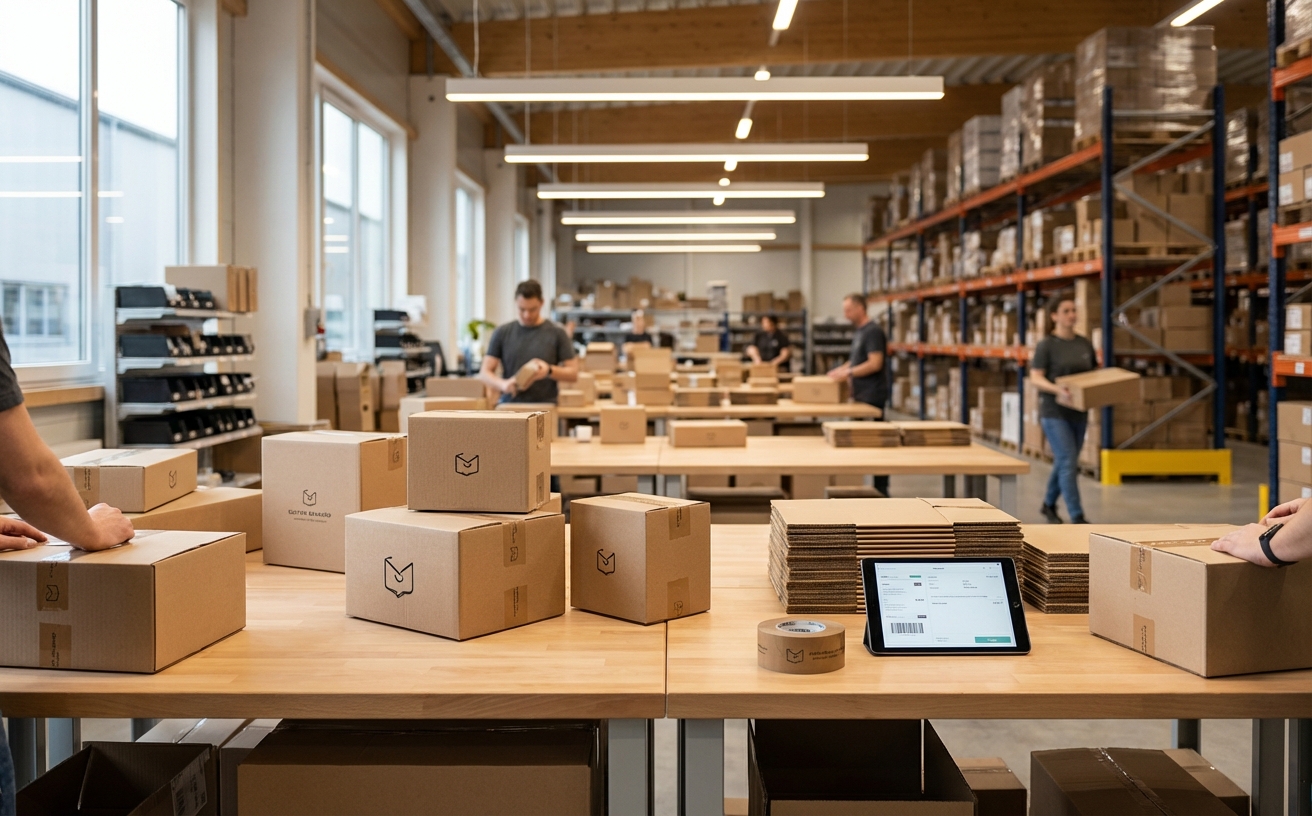
Custom Packaging for E-commerce: The Complete Guide
Your product might be excellent. But the first thing your customer actually touches is the packaging. That physical moment — tearing open a box, pulling back tissue paper, seeing your brand for the first time in person — shapes how people feel about what they bought.
Custom packaging isn't decoration. It's a communication tool. It tells your customer who you are, how much care you put into the details, and whether they made the right choice.
This guide covers the full picture: types of packaging, how to choose the right option, what the process looks like, what it costs, and what mistakes to avoid. Whether you're shipping 100 orders a month or 10,000, you'll walk away knowing exactly what to do next.
Why Custom Packaging Matters for E-commerce Brands
When you sell online, you don't have a storefront. You don't have a salesperson handing someone a bag. The package is your store. It's the only physical brand experience most of your customers will ever have.
The First Touchpoint
Think about how your product arrives. A plain brown box with a shipping label tells the customer nothing. A branded mailer with your logo, a clean interior, and a printed thank-you card tells them: this company pays attention.
That distinction matters more than most sellers realize. According to packaging industry data, 72% of consumers say packaging design influences their purchasing decisions. For e-commerce, where you can't offer the in-store experience, the package carries even more weight.
The Unboxing Effect
Unboxing has become its own category of content. Customers share packaging on social media, in reviews, and in word-of-mouth recommendations. A well-designed package doesn't just protect your product — it earns you visibility you didn't pay for.
You don't need luxury-tier packaging to get this effect. A clean design, consistent color palette, and a thoughtful insert can make a standard mailer box feel intentional. The bar isn't perfection. It's showing that you thought about it.
Driving Repeat Purchases
Custom packaging reinforces trust. When someone reorders, they already know what to expect. The package becomes a recognizable signal — they see your brand on the doorstep and feel good before they even open it.
Repeat customers spend 67% more on average than first-time buyers. If your packaging contributes to that return rate, even modestly, the investment pays for itself quickly.
Types of Custom Packaging for Online Orders
Not every product needs the same packaging. A 6 oz candle and a 15-pound electronics kit have different requirements. Here's what's available and when each type makes sense.
Mailer Boxes
Mailer boxes are the most popular option for direct-to-consumer e-commerce. They're rigid, self-locking, and print beautifully on both interior and exterior surfaces. Most are made from corrugated cardboard (E-flute or B-flute) and fold flat for storage.
Best for: apparel, cosmetics, subscription boxes, gifts, and anything where the unboxing experience matters. Typical sizes range from 6" x 4" x 2" up to 16" x 12" x 6". Minimum orders usually start at 100-250 units depending on the supplier.
Poly Mailers
Poly mailers are lightweight, tear-resistant plastic envelopes. They're significantly cheaper to ship than boxes because they weigh almost nothing and conform to the product shape, reducing dimensional weight charges.
Best for: clothing, soft goods, accessories, and non-fragile items. You can print full-color designs directly on the poly material. If you're shipping T-shirts, hats, or scarves, poly mailers cut your shipping costs by 30-50% compared to boxes.
Corrugated Shipping Boxes
Standard corrugated boxes are the workhorse of e-commerce shipping. They come in single-wall, double-wall, and triple-wall options depending on the weight and fragility of your product.
Best for: heavy items, fragile products, multi-item orders, and anything that needs structural protection during transit. Custom-printed corrugated boxes cost more per unit than mailer boxes, but they're essential for products over 5 pounds or items that can't tolerate compression.
Inserts and Protective Packaging
Inserts sit inside your box and hold the product in place. They also create a more polished presentation. Options include:
- Die-cut cardboard inserts: Custom-shaped to cradle your product. Common for cosmetics, electronics, and gift sets.
- Tissue paper: Printed or plain. Adds a layer of discovery to the unboxing. Costs as little as $0.05-0.15 per sheet in bulk.
- Crinkle paper or shredded fill: Affordable void fill that adds color and texture.
- Foam inserts: For fragile or high-value items. More expensive, but necessary for products like glassware or electronics.
Labels, Stickers, and Tape
If custom boxes aren't in your budget yet, branded labels and stickers are the easiest entry point. A 2" round logo sticker on a plain kraft mailer looks clean and intentional. Custom packing tape with your brand name turns any brown box into branded packaging.
Sticker minimums are often as low as 50-100 units. Custom tape starts around 24-36 rolls per order. This is the lowest-cost way to start building brand recognition through packaging.
How to Choose the Right Packaging for Your Products
Choosing packaging involves balancing 4 factors: product needs, brand positioning, volume, and sustainability goals. Here's how to think through each one.
Size, Weight, and Fragility
Start with the product. Measure the actual dimensions and weight of your most common items. Then add 1-2 inches of clearance on each side for protective material.
Oversized packaging wastes money in two ways: you pay more for the box itself, and you pay more in shipping (carriers charge by dimensional weight, not just actual weight). A box that's 2 inches too large on each side can push you into a higher shipping tier. Measure carefully.
For fragile items, the packaging needs to absorb impact. Double-wall corrugated with foam inserts is standard for electronics and glassware. For semi-fragile items like ceramics, a single-wall box with die-cut inserts usually works.
Brand Positioning
Your packaging should match the experience your customer expects at your price point. A $12 T-shirt doesn't need a rigid box with foil stamping. A $200 skincare set shouldn't arrive in a plain poly mailer.
Think about your brand's visual identity. If your website is minimal and clean, your packaging should be too — white boxes, simple typography, one or two colors. If your brand is bold and colorful, bring that energy to the print design. Consistency between your digital and physical brand builds trust.
Volume and Budget
Custom packaging has volume-based pricing. The more you order, the lower the per-unit cost. Here's a rough guide:
- 100-500 units: Expect to pay a premium. Good for testing designs before committing to a large run.
- 500-2,000 units: The sweet spot for most small e-commerce brands. Per-unit costs drop significantly.
- 2,000-10,000 units: Volume pricing kicks in. You'll save 20-40% per unit compared to minimum orders.
- 10,000+ units: Best pricing available. Make sure your design is finalized — changes at this volume are expensive.
If you're just starting, order enough to last 3-6 months. This gives you time to evaluate the design, gather customer feedback, and make adjustments before your next order.
Sustainability
Customers care about packaging waste. A 2025 survey found that 67% of consumers consider sustainable packaging when making purchase decisions. More importantly, many will pay slightly more for it.
Practical sustainable options include:
- Recycled cardboard: Most custom mailer boxes can be made from 70-100% recycled content with no loss in quality.
- Soy-based inks: Standard at most printers now. No additional cost.
- Right-sized packaging: The most impactful sustainability move is simply using less material. Smaller boxes = less waste = lower shipping emissions.
- Compostable poly mailers: Available from several suppliers. Costs 10-20% more than standard poly but increasingly expected by eco-conscious customers.
The Custom Packaging Process: From Design to Delivery
If you've never ordered custom packaging before, the process is straightforward. Here's what to expect at each stage.
Design Files
You'll need to provide artwork that fits the specific box dimensions. Most suppliers provide a dieline template — a flat layout of the box that shows where panels, folds, and glue flaps are. You design within those boundaries.
File requirements are typically:
- Format: Adobe Illustrator (.ai) or PDF with vector artwork
- Resolution: 300 DPI minimum for any raster/photo elements
- Color mode: CMYK (not RGB — screen colors don't translate directly to print)
- Bleed: 3mm beyond the trim line on all printed edges
If you don't have a designer, many packaging suppliers offer design assistance. At Anybigworks, we provide dieline templates for every product and can connect you with design support. Browse our custom packaging catalog to see available formats.
Materials and Finishes
Once your design is ready, you'll choose materials and finishes:
- Paper stock: White kraft, natural kraft, or coated white. White kraft is the most versatile for printing.
- Print method: Digital (best for short runs under 1,000), flexographic (cost-effective for 1,000-10,000), or offset lithography (best quality for 10,000+).
- Coatings: Matte, gloss, or soft-touch lamination. Matte is the current industry standard for a modern look. Soft-touch adds a tactile premium feel.
- Special finishes: Foil stamping (metallic accents), embossing/debossing (raised or recessed textures), spot UV (selective gloss effect). Each adds $0.05-0.50 per unit depending on coverage area.
Proofing
Before production begins, you'll receive a proof. This is either a digital mockup (a 3D rendering of your design on the box) or a physical sample (an actual printed and assembled box).
Digital proofs are free and take 1-2 business days. Physical proofs cost $50-150 and take 5-7 business days, but they're worth it for first-time orders. You can check the color accuracy, material feel, structural integrity, and fit with your actual product.
Never skip the proof step. Color on a screen looks different than color on cardboard. A proof catches issues that save you thousands on a full production run.
Production Timelines
Standard production timelines vary by method and quantity:
- Digital printing (100-1,000 units): 7-10 business days
- Flexographic printing (1,000-10,000 units): 10-15 business days
- Offset lithography (10,000+ units): 15-20 business days
Add 3-7 business days for shipping to your warehouse. Rush production is available from most suppliers at a 15-25% surcharge. If you need packaging for a product launch or seasonal campaign, plan at least 4-6 weeks ahead.
Custom Packaging Costs: What Affects Your Price
Packaging pricing depends on several factors. Understanding them helps you make informed trade-offs between cost and quality.
Material
The box material is the biggest cost driver. Here's what to expect for a standard mailer box (10" x 8" x 4"):
- White kraft corrugated (E-flute): $0.80-1.50 per unit at 500 quantity
- Natural kraft corrugated: $0.70-1.30 per unit (slightly cheaper, no white coating)
- Rigid setup box: $3.00-8.00 per unit (luxury tier, for high-end products)
Print Method
- 1-2 color flexo: Lowest cost per unit for runs over 1,000. Limited to spot colors.
- Full-color digital: Higher per-unit cost, but no plate fees. Best for runs under 1,000 or designs with photos/gradients.
- Full-color offset: Lowest per-unit cost at 10,000+, but plate setup fees of $200-500.
Quantity and Volume Pricing
Volume has the biggest impact on price. A mailer box that costs $2.00 each at 250 units might cost $0.90 at 2,500 units. That's a 55% reduction. Most suppliers offer tiered pricing, and the biggest jumps happen between 250→500, 500→1,000, and 1,000→2,500 units.
Check our pricing page for transparent volume-based pricing on standard packaging formats.
Special Finishes
Each finish adds incremental cost:
| Finish | Additional Cost Per Unit |
|---|---|
| Matte lamination | $0.05-0.15 |
| Gloss lamination | $0.05-0.15 |
| Soft-touch lamination | $0.10-0.25 |
| Foil stamping (small logo) | $0.10-0.30 |
| Embossing/debossing | $0.08-0.25 |
| Spot UV | $0.10-0.30 |
These costs scale with quantity — finishes get cheaper per unit on larger runs. For most e-commerce brands, matte lamination is the best value: it protects the print, feels good in hand, and costs pennies per box.
Price Ranges Summary
For a typical e-commerce mailer box (custom printed, 1-2 color exterior, matte finish):
- 250 units: $1.80-2.50 per box
- 500 units: $1.30-1.80 per box
- 1,000 units: $0.95-1.40 per box
- 2,500 units: $0.75-1.10 per box
- 5,000 units: $0.55-0.85 per box
These are ballpark figures. Your actual price depends on exact dimensions, material choice, and print complexity. Request a quote for pricing specific to your product.
Common Mistakes to Avoid
We've seen thousands of packaging orders. These are the mistakes that cost brands the most time and money.
Over-Engineering the Design
More isn't always better. A 6-color print with foil stamping, embossing, and a custom tissue paper insert looks impressive — but if your product sells for $25, the packaging cost can eat your margin.
Start simple. A 1-2 color print on kraft material with a clean logo and minimal text creates a strong impression at a fraction of the cost. You can upgrade finishes later as your order volume grows and per-unit costs drop.
Ignoring Dimensional Weight
Carriers like UPS, FedEx, and USPS charge based on the greater of actual weight or dimensional weight. Dimensional weight is calculated from the package size: length x width x height, divided by a dimensional factor (typically 139 for domestic shipping).
A box that's 2 inches larger than necessary on each axis can push your dimensional weight above the actual weight threshold. On 1,000 shipments per month at $1.50 extra per package, that's $1,500 in unnecessary shipping costs. Right-size your packaging to your product.
Skipping the Proof
We mentioned this above, but it bears repeating. Proofing costs $50-150. Reprinting 2,000 boxes because the color is wrong costs $1,500-3,000. The math is straightforward.
Even if you've ordered the same design before, request a proof when you change suppliers, switch materials, or modify the artwork. Print output varies between production facilities.
Ordering Too Few
Ordering 100 units to "test" is understandable, but it's the most expensive way to buy packaging. You'll pay 2-3x the per-unit cost compared to ordering 500 or 1,000.
A better approach: order 500 units of a simple design. This gets you into a reasonable price tier and gives you enough stock to run a genuine test with real customers over 2-3 months. If the design works, scale up. If you want to change it, 500 units won't gather dust for long.
Getting Started with Custom Packaging
Custom packaging doesn't need to be complicated or expensive. The key is matching your packaging to your product, your brand, and your budget — then ordering enough volume to keep per-unit costs reasonable.
Start Where You Are
If you're shipping fewer than 200 orders a month, start with branded stickers or custom tape on plain boxes. The investment is minimal and you get immediate brand visibility.
If you're shipping 200-1,000 orders a month, custom mailer boxes make financial sense. At 500+ units, per-unit costs are competitive, and the brand impact is significant.
If you're shipping 1,000+ orders a month, you're in the volume tier where custom packaging becomes a competitive advantage. Explore premium finishes, custom inserts, and multi-component packaging that creates a memorable unboxing experience.
Off-the-Shelf vs. Fully Custom
You don't have to design from scratch. Many suppliers, including Anybigworks, offer standard packaging formats in common sizes that you can customize with your artwork. This saves time on structural design and reduces minimums.
Fully custom structural design (unique box shapes, custom closures, specialty constructions) is available for brands with specific requirements, but it adds 2-3 weeks to the timeline and requires higher minimums — typically 1,000+ units.
Next Steps
Whether you know exactly what you need or you're exploring options, there are two ways to move forward:
- Browse the catalog: See standard packaging formats with instant pricing and lead times.
- Request a quote: Tell us about your product and we'll recommend packaging options with detailed pricing.
Ready to find the right packaging for your products? Browse Custom Packaging for instant pricing on standard formats, or Get a Packaging Quote for a recommendation tailored to your specific needs.