Custom Products vs. Off-the-Shelf: When to Invest
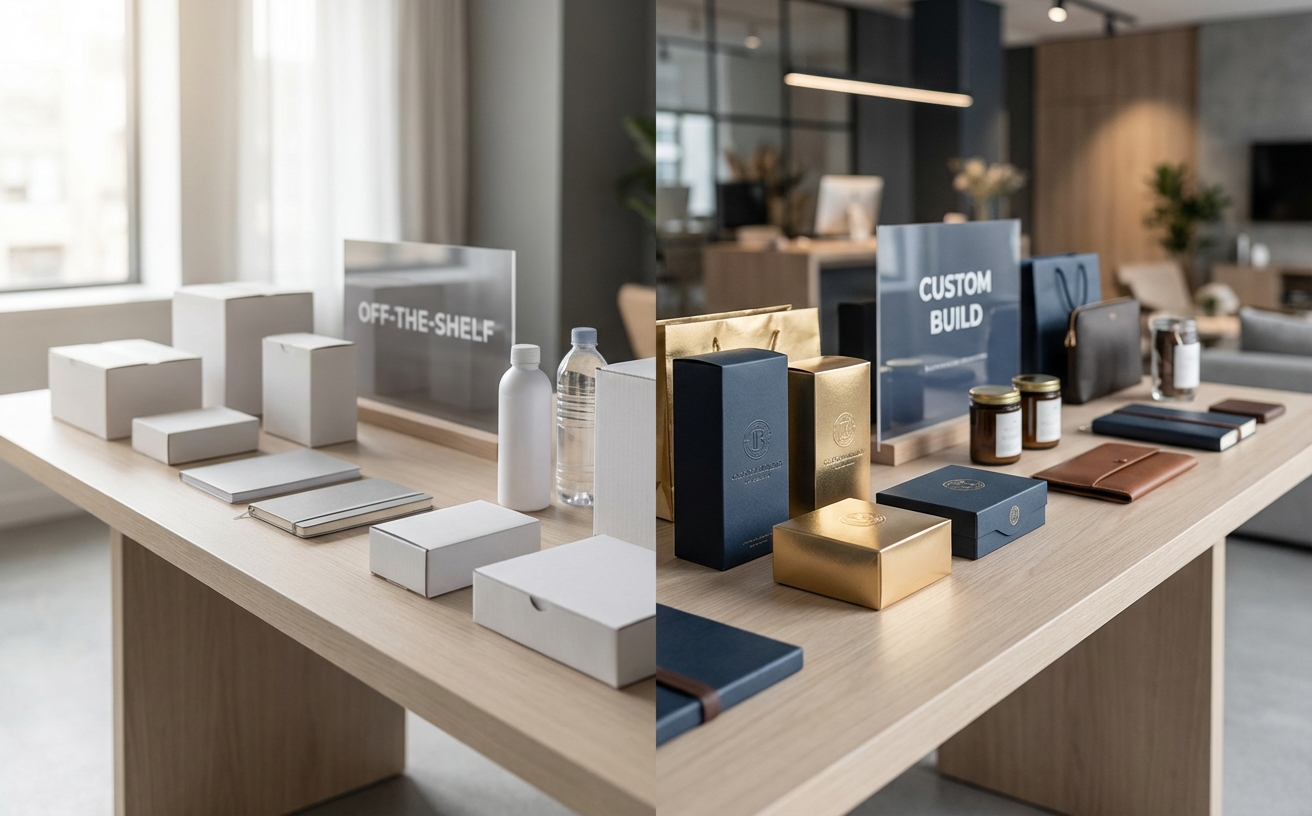
Custom Products vs. Off-the-Shelf: When to Invest
Every purchasing decision comes down to a version of this question: do you buy what already exists, or do you build something made for you?
Off-the-shelf products are fast, affordable, and simple. Custom products carry your brand, meet exact specifications, and stand out. The right answer depends on your goals, your quantities, and how much the details matter for your use case.
This isn't a debate with a universal winner. It's a decision framework. Here's how to think through it clearly.
The Case for Off-the-Shelf Products
Off-the-shelf products exist because they work. Standard items cover most needs, ship quickly, and keep costs low — especially at small quantities. There's no shame in choosing generic when generic gets the job done.
Speed matters. Off-the-shelf products ship in 1-3 business days from most suppliers. Custom products require design approval, production setup, and manufacturing time — typically 2-4 weeks. If you need items for an event next Friday, off-the-shelf is your only realistic option.
Low quantities stay affordable. When you need 10-25 units, custom production costs are hard to justify. Setup charges, plate fees, and minimum runs mean you're paying a significant per-unit premium at small volumes. A standard product with no customization avoids all of those costs.
Sometimes generic is fine. Internal supplies, back-of-house items, one-time event giveaways that won't be reused — these don't need your logo. A plain white mug at a team meeting serves the same functional purpose as a branded one. Save your custom budget for items that will be seen by customers, prospects, or the public.
Lower risk on new items. Trying a new product category? Off-the-shelf lets you test the concept without committing to a custom production run. If the product type works for your audience, you can invest in a custom version for the next round.
Simpler logistics. Off-the-shelf items ship from existing inventory. There's no approval cycle, no proof review, no production queue. You order on Monday and receive on Thursday. For teams without a dedicated procurement process, that simplicity has real value.
The Case for Custom Products
Custom products cost more upfront. They take longer to produce. They require decisions about colors, materials, and placement. But they deliver something off-the-shelf never can: differentiation.
Brand consistency across touchpoints. Your website, your packaging, your team's apparel, your trade show booth — every touchpoint either reinforces your brand or dilutes it. Custom products in your exact colors, with your logo placed intentionally, create a cohesive experience. Off-the-shelf products in "close enough" colors create visual noise.
You stand out. At a trade show with 200 booths, everyone has pens. The company with custom-designed notebooks in a distinctive color gets remembered. In a client gift box, a branded item with thought behind it signals investment. A generic item signals obligation.
Exact specifications. Off-the-shelf means accepting what's available. Custom means specifying the material weight, the Pantone color, the print location, the packaging style, and the finish. When the details matter — and for client-facing items, they usually do — custom gives you control.
Long-term cost efficiency. Here's the part that surprises people: at volume, custom products often cost the same as or less than off-the-shelf. Once you've covered the initial setup, the per-unit cost drops significantly. A company ordering 500 custom t-shirts per year pays less per shirt than a company buying 50 blanks and hoping the color matches.
Decision Framework: 5 Questions to Ask
Before defaulting to either option, run your project through these 5 questions. If you answer "yes" to 3 or more, custom is likely worth the investment.
1. Will this item represent your brand to external audiences?
If customers, prospects, partners, or the public will see it, brand consistency matters. Trade show giveaways, client gifts, retail packaging, employee apparel worn in public — these are all brand impressions. Internal-only items (office supplies, back-of-house materials) carry less brand weight.
2. Are you ordering more than 50 units?
At 50+ units, custom production costs become reasonable. Setup charges get absorbed across more pieces, and per-unit pricing approaches — or matches — off-the-shelf alternatives. Below 50, the math usually favors standard products unless brand impact is critical.
3. Do you need specific materials, colors, or dimensions?
If the available off-the-shelf options don't match your requirements — wrong shade of blue, too small, wrong material — you'll spend time searching for a compromise that may not exist. Custom production eliminates the compromise.
4. Will you reorder this item regularly?
Items you order once don't justify custom setup costs. Items you reorder quarterly or annually do. The setup cost is a one-time expense; every reorder benefits from it. If you know you'll need 200 branded notebooks every quarter, the custom version pays for itself by the second order.
5. Does this item need to match other branded materials?
If you're building a kit, a gift set, or a coordinated campaign, consistency across items matters. A custom tumbler that matches your custom box that matches your custom card creates a unified impression. An off-the-shelf tumbler in "sort of your blue" next to a precisely branded card looks careless.
Cost Comparison by Product Type
Real numbers make better decisions than guesses. Here's how off-the-shelf and custom compare across common product categories.
| Product | Off-the-Shelf (25 units) | Custom (25 units) | Custom (100 units) | Custom (500 units) |
|---|---|---|---|---|
| T-Shirt | $8-$12 each | $15-$22 each | $10-$15 each | $7-$11 each |
| Tote Bag | $4-$8 each | $10-$16 each | $7-$11 each | $5-$8 each |
| Notebook | $3-$6 each | $9-$14 each | $6-$9 each | $4-$7 each |
| Water Bottle | $6-$10 each | $14-$20 each | $10-$14 each | $7-$10 each |
| Sticker Pack | $1-$2 each | $4-$6 each | $2-$4 each | $1-$2 each |
| Packaging Box | $1-$3 each | $5-$10 each | $3-$6 each | $2-$4 each |
The break-even point for most products falls between 100 and 250 units. Below that, you're paying a meaningful premium for customization. Above it, custom per-unit costs drop to within 10-20% of off-the-shelf — and often match them entirely at 500+.
The break-even calculation shifts for items with high brand visibility. A $3 premium per unit on a trade show giveaway that 500 people will carry around a convention floor is a different ROI equation than a $3 premium on internal office supplies.
Don't forget hidden costs on the off-the-shelf side. When you buy generic products and try to make them feel branded — adding stickers, printing inserts, choosing "close enough" colors — you spend time and energy that doesn't show up in the unit price. Three hours searching for a tumbler in the right shade of blue, then settling for one that's slightly off, has a real cost. Custom eliminates that search entirely.
The Middle Ground: Semi-Custom Options
Full custom isn't the only alternative to off-the-shelf. Semi-custom — adding your logo or brand elements to a standard product — delivers most of the brand value at a fraction of the cost and lead time.
Logo imprint on standard products. Take an existing product in a color that matches your brand and add your logo. A standard black tumbler with a one-color logo print costs 30-50% less than a fully custom-designed tumbler, and production time drops from 3-4 weeks to 1-2 weeks. For many use cases, this is the smart play.
80% of the value at lower cost. The honest truth: most people won't notice whether your tumbler was designed from scratch or whether your logo was added to an existing shape. They'll notice your brand is on it, the color looks right, and the quality is solid. Semi-custom gets you there without the design fees and extended timelines.
Where full custom still matters. Packaging is the clearest example. A custom-designed box with interior printing, specific dimensions for your product mix, and branded tissue paper creates an experience that a sticker on a brown box can't replicate. Client-facing gift sets, retail products, and high-visibility items justify full custom because the presentation is the product.
Other cases for full custom: products where dimensions matter (displays, signage, packaging for specific items), items where material choice affects function (apparel fabric weight, drinkware insulation), and programs where brand precision is non-negotiable (retail environments, franchise kits).
Browse our catalog to see which products are available in standard, semi-custom, and fully custom configurations.
How to Start Small with Custom Products
You don't need to commit to a 1,000-unit custom order to test the waters. Start small, learn what works, and scale when you're confident.
Start with a pilot order. Most custom products can be ordered in quantities as low as 25-50 units. Pick one product category — the one with the highest brand visibility for your use case — and order a small custom run. Use it alongside your existing off-the-shelf items and compare the response.
Pick one category first. Don't try to customize everything at once. If you're building employee kits, start with custom apparel — it's the most visible item. If you're preparing for a trade show, start with the giveaway item attendees will carry around. Nail one category before expanding.
Compare side by side. When evaluating results, look beyond unit cost. Track how long each item stays in use, whether recipients comment on it, and how it holds up after a month. A $12 custom notebook that sits on someone's desk for 6 months delivers more brand exposure than a $5 generic notebook that gets tossed in a drawer after a week.
Use the quote process to compare. The best way to evaluate custom vs. off-the-shelf is to get actual pricing for your specific quantities. Request a quote for the custom version and compare it against what you're currently paying for standard products. The gap is often smaller than expected, especially at moderate volumes.
At Anybigworks, we price custom and standard options side by side so you can make an informed decision. You'll see exactly what customization adds at your quantity, with no guessing.
Not sure if custom is right for your project? Browse our catalog to compare options, or request a quote to see what custom would cost.
Ready to explore your options?
Browse Products | Get a Custom Quote
Related reading: